A Critical Analysis of the 2026 FIFA World Cup: Geopolitics, Exclusion and Power
🌐 Este artigo também está disponível em português 🇧🇷 Leia aqui
🌐 Este artículo también está disponible en español 🇪🇸 Lee aquí
When the ball starts rolling, the world seems to stand still. For a few weeks, millions of people share emotions, celebrate victories and turn football into a universal language. Yet behind the spectacle, the packed stadiums and the narrative of global unity, the 2026 FIFA World Cup also exposed some of the defining political, economic and social tensions of our time.

The question "Who really won the World Cup?" therefore has more than one answer. Beyond the Spanish national team's well-deserved triumph, the tournament invites us to ask which interests were strengthened, which narratives were legitimised and which realities were rendered invisible during the world's biggest sporting event.
FIFA, Politics and the Economics of Spectacle
To understand who truly wins a World Cup, one need only follow the money. FIFA, the governing body of international football, oversees an industry whose revenues rival the economies of some sovereign states. While the 2022 FIFA World Cup in Qatar generated a record US$7.6 billion in revenue, the 2026 edition—the first to feature 48 national teams and to be jointly hosted by the United States, Canada and Mexico—confirmed the tournament's commercial expansion, with estimated revenues of US$13 billion, making it the most lucrative sporting event on the planet.

This growth, however, raises important questions about the model driving modern football. Rising ticket prices, increasingly expensive hospitality packages and the growing commercialisation of the World Cup experience have made the tournament less accessible to many traditional supporters, gradually transforming what was once conceived as a popular celebration into a spectacle increasingly tailored to affluent consumers.

The tournament's political dimension also became impossible to ignore. During the official World Cup Final Draw, held in Washington on 5 December 2025, FIFA President Gianni Infantino presented the inaugural FIFA Peace Award to the President of the United States, Donald Trump. The decision sparked intense international debate over FIFA's political neutrality and the criteria used to grant such a distinction.

Within this complex web of power, politics and sport converged in what some commentators dubbed the "Trump Power Play"—the controversial intervention by the US President in the review of the suspension imposed on Folarin Balogun following his dismissal. The episode reignited concerns about FIFA's independence and highlighted the extent to which major sporting competitions can become vulnerable to political influence.
Identity, Migration, Borders and LGBTQI+ Rights
As a tournament jointly hosted by the United States, Mexico and Canada, the 2026 FIFA World Cup unfolded against a backdrop of strict immigration and security policies, turning the experience into a genuine challenge for several national delegations. Iran's national team, for example, was required to play its matches in the United States while establishing its training base in Mexico due to restrictions imposed by the host country. Iraqi striker Aymen Hussein was detained and questioned for seven hours by US border authorities, while Somali referee Omar Abdulkadir Artan, despite holding a valid visa and official FIFA accreditation, was denied entry to the country and excluded from the tournament.

The restrictions also affected members of the media and delegation staff. Talal Salah, the Iraqi national team's photographer, was detained for more than ten hours before being refused entry by the US authorities. Likewise, several Iranian and African journalists were unable to obtain the visas required to cover the tournament, while thousands of Iranian supporters saw their travel plans thwarted by difficulties entering the United States and problems related to ticket allocation. Far from being isolated incidents, these episodes illustrated how the host country's immigration policies shaped the participation of players, referees, journalists and supporters, projecting an image that contrasted sharply with the universal and inclusive values FIFA claims the World Cup represents.

The climate for so-called "minority groups" was equally marked by controversy. The British organisation Three Lions Pride, which represents England's LGBTQI+ supporters, decided not to send an official delegation to the World Cup, arguing that it could not guarantee the safety of its members in light of the political climate and restrictive legislation in force across several US states. Similarly, Amnesty International and Human Rights Watch warned that insufficient measures were in place to protect LGBTQIA+ people, journalists and migrants during the tournament.

Nevertheless, there were also acts of resistance. During the match between Iran and Egypt, FIFA rejected requests to ban rainbow flags from the stadium, allowing supporters to display them as symbols of diversity. Yet incidents of intolerance persisted both inside and outside the stadiums. FIFA itself reported that, during the group stage alone, its monitoring system detected more than 89,000 abusive posts, hid 181,000 comments, and referred nearly 1,000 accounts for investigation, in a context marked by racist, homophobic and other forms of hate speech.
Who Really Won the World Cup?
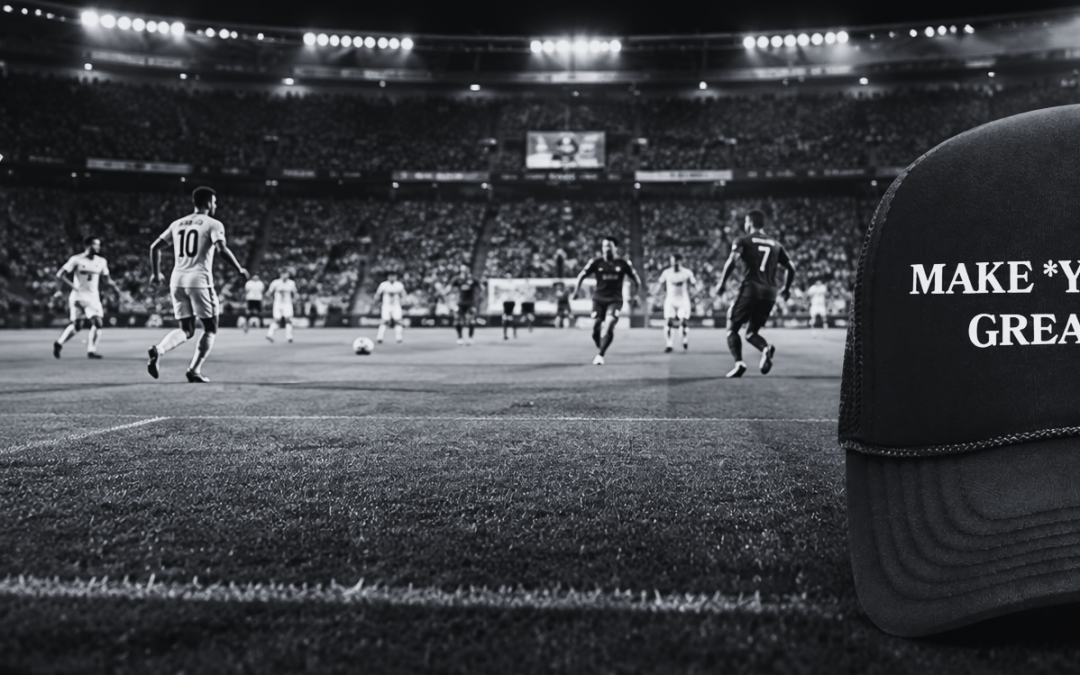
Spain deservedly lifted the FIFA World Cup trophy. Yet beyond the glitter of sporting success, the tournament ultimately proved to be a powerful reflection of our times: a stage upon which the consolidation of new global power structures became increasingly apparent. And amid the well-deserved celebrations of Spain's second World Cup title, the "Make Spain Great Again" cap came to symbolise that broader trend, conveying a political message that stood in stark contrast to the reality of the champions themselves: a team forged through the collective efforts of players from different ethnic backgrounds, cultures, origins and accents.
Nothing more.

Greetings from Middle-earth,

Alan Leites 🌻
More about my literary work at alanleites.com
Image: internet

🌐 Portuguese version 🇧🇷 Read here
🌐 Spanish version 🇪🇸 Read here